


TMTPOST -- SpinQ Technology, a leading player in China’s quantum computing race, has raised several hundred million yuan in a Series B funding round, the company announced on Sunday, signaling intensifying investor appetite for the frontier field despite global competition and commercialization hurdles.
Backers of the round include state-affiliated funds such as CCB Equity and Liangxi Science City Development Fund, alongside private capital firms Starry Sky Investment, Huaqiang Capital, and Jiusong Fund. The Shenzhen-based company said proceeds will be used to expand research and development, enhance production capacity for its superconducting quantum computers, and grow its global team.
Founded in 2018, SpinQ is among China’s most ambitious quantum hardware companies. Led by physicist and CEO Xiang Jingen, the company has built a vertically integrated ecosystem encompassing superconducting and NMR (nuclear magnetic resonance) quantum computers, cloud platforms, and quantum software. Its solutions are now deployed in over 200 institutions across more than 40 countries, according to Xiang.
“We are scaling toward medium-sized quantum processors and practical commercial systems,” Xiang told AsianFin in an extended interview. “Our roadmap includes a superconducting quantum computer with hundreds of qubits by the end of 2025.”
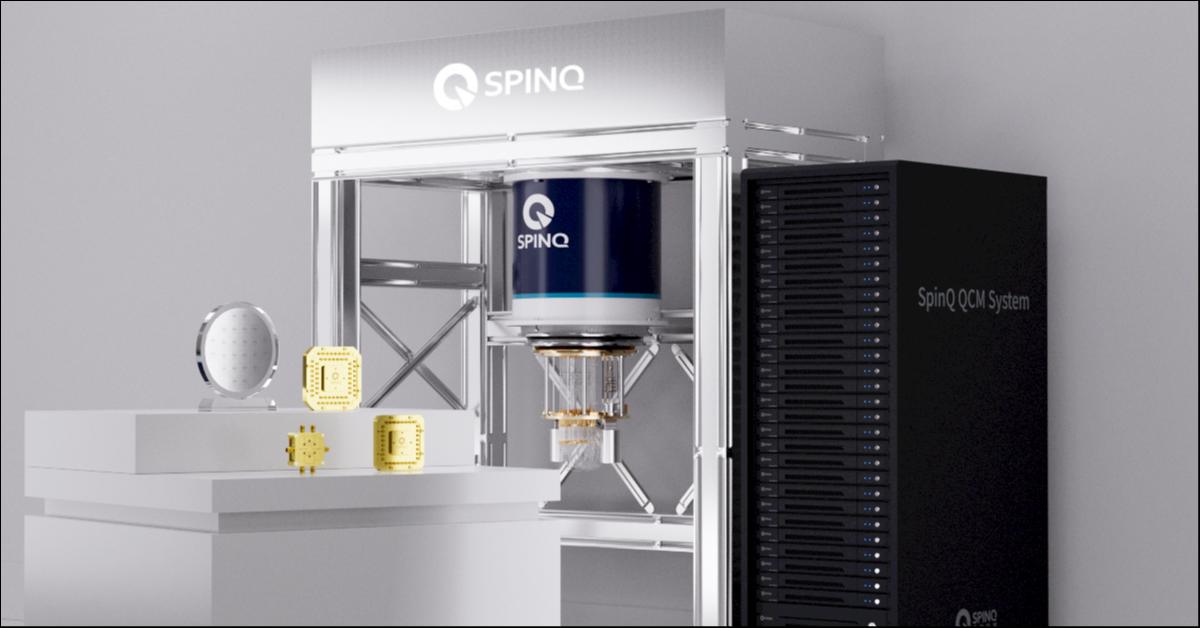
SpinQ’s flagship superconducting chip, Shaowei, launched in 2023, boasts long qubit lifetimes and high fidelity—two key performance indicators for practical quantum computing. That same year, the company completed China’s first export of a superconducting quantum chip to the Middle East, and in 2024 delivered a full quantum computer overseas.
Xiang said SpinQ’s superconducting and NMR quantum products contribute equally to revenue and are primarily used in research and education settings. Its quantum lineup includes the Ursa Major full-stack quantum computer, the Shaoweichip, and its own measurement and control systems.
The company’s push into superconducting quantum computing pits it against giants like IBM and Google. According to Xiang, superconducting technology remains the fastest-developing route due to its scalability, industrial maturity, and overlap with traditional semiconductor manufacturing. “Superconducting chips share processes, equipment, and talent pools with the classical chip industry, giving us a real acceleration advantage,” he said.
The global market for quantum computing could reach $2.8 billion to $7.2 billion by 2035, according to McKinsey, with broader quantum technologies approaching a $10 billion market size. But significant technical barriers remain, particularly around quantum error correction—necessary for fault-tolerant and general-purpose machines.
SpinQ aims to cross two critical milestones on this path. The first, expected by 2029, involves building quantum computers with thousands of qubits and 0.999 fidelity. The second, around 2035, envisions universal machines with millions of logical qubits—requiring over 1 billion yuan in investment.
Xiang believes current expectations, including those from NVIDIA’s Jensen Huang, may underestimate the pace of quantum development. “The number of logical qubits could increase 1,000-fold over a decade, not just 100-fold,” he said, referencing the so-called “Quantum Moore’s Law.”
Unlike some peers, SpinQ designs and fabricates its own superconducting chips in-house—a move Xiang says is critical for performance, speed of iteration, and security. While public research platforms in China can take two months to process a chip, SpinQ’s internal lab can complete the task in just five days, he said.
“We're not just a research company—we’re building and selling products,” said Xiang, who holds degrees from Tsinghua University and the University of Waterloo and previously conducted research at Harvard.
The company’s hands-on control of its supply chain reflects a broader push within China’s deep tech sectors for domestic self-reliance amid geopolitical tensions and export restrictions.
Xiang also highlighted growing synergies between AI and quantum computing. As systems scale up, AI techniques can help optimize qubit control and calibrate quantum pulses. Conversely, quantum computing may eventually provide vast computing power for next-generation AI applications.
Yet SpinQ remains cautious about hyping capabilities prematurely. “Quantum computing cloud platforms are still early. They enable access but cannot yet solve real industrial-scale problems,” Xiang said. “There’s a danger when companies overstate what’s possible today.”
While tech heavyweights like Alibaba and Baidu have scaled back their quantum programs in favor of large AI models, SpinQ is doubling down. “We benchmark ourselves against IBM and IQM—not domestic peers,” Xiang said. “Our ultimate goal is to independently develop a fault-tolerant, universal quantum computer using the superconducting route.”
Looking ahead, SpinQ plans to invest hundreds of millions of yuan into R&D while commercializing certain technologies to maintain cash flow. “Quantum computers won’t be fully practical in the short term, but we’re laying the groundwork for long-term disruption,” he said.
The company’s focus spans three tracks: deepening product development, targeting application scenarios in finance, biomedicine, and AI, and expanding globally through new partnerships and implementations.
“We want to build new productive forces,” Xiang said. “Not by making noise, but by delivering.”

 快报
快报
根据《网络安全法》实名制要求,请绑定手机号后发表评论